
The history of Montemagno Monferrato in ten moments

Montemagno Monferrato is a hilltop village in Piedmont whose thousand‑year history mixes a medieval castle, royal family ties, and a UNESCO‑listed wine landscape.
A thousand years through one Piedmontese village
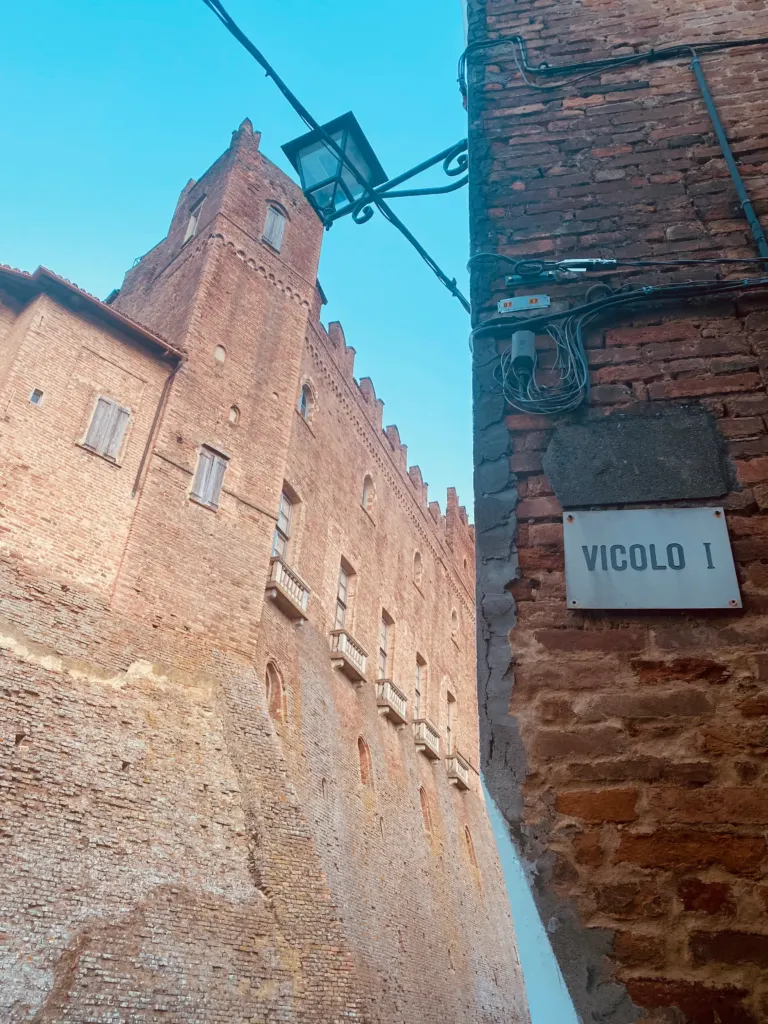
Montemagno Monferrato sits on a ridge in the Asti hills, forty minutes from the city of Asti, with striped vineyards on three sides and a quiet that starts at the edge of the village. To anyone walking through it today, the borgo layout is immediately intelligible: a triangular settlement crossed by twelve narrow lanes, each marked with a Roman numeral, converging on a central piazza and a castle on the rise above it.
Underneath that legibility sits one of the more eventful biographies of any small village in northern Italy. What follows is a sequence of ten moments, in order, that explain why the place feels the way it feels.
1. 963: the Marchesato is born
In 963 the Holy Roman Emperor Otto I granted a vast territory between the rivers Tanaro and Orba to a Frankish-Salian marquis named Aleramo. From that act emerged the Marchesato del Monferrato, one of the most durable feudal states in medieval Italy, surviving in some form until 1708. Montemagno does not yet appear by name in the documents; the hill on which it now stands is simply part of a frontier landscape being slowly reorganised.
2. 981: the first keep
The earliest documentary trace of the Castello di Montemagno dates to 981. At that point the structure is a single circular keep surrounded by a wall and a moat: a watchtower controlling the road, built to signal to neighbouring hilltops and hold the line. The village will grow around it over the following two centuries, taking the triangular shape that survives intact today, with its twelve numbered lanes running like ribs from a central spine.
3. 1269 and 1290: the wars with the Marchesi
By the 13th century, Montemagno is an ally of Asti, the powerful free comune nearby, and the two powers clash repeatedly with the Marchesi del Monferrato. Montemagno pays the price: the castle suffers serious damage in 1269 and partial destruction in 1290. The village absorbs the shock and rebuilds.
4. Early 14th century: the pointed-arch windows
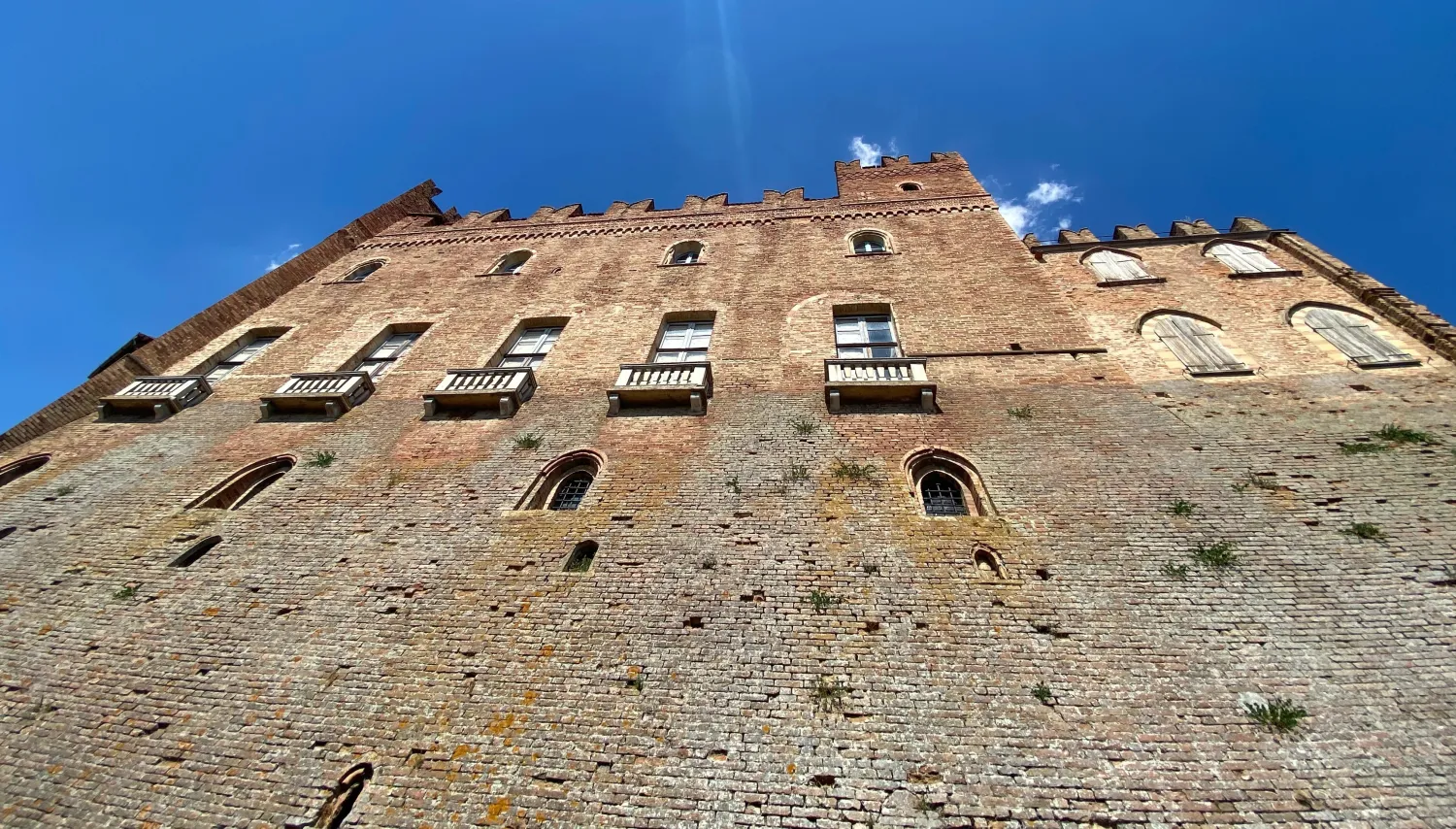
The castle is rebuilt in the first decades of the 1300s, and the architectural language of this campaign is the one still readable today: pointed-arch windows decorated with polychrome frames alternating cotto and tufo, the characteristic Astigiano mark, and an ornamental crowning frieze along the wall. Through this period the twelve lanes consolidate as the durable urban grid of the place. Among them, Vicolo 10 holds, seven centuries later, one of the Ahoma houses.
5. 15th century: an oath to the Savoy
During the 1400s the lords of Montemagno swear loyalty to the dukes of Savoy, a choice that proves decisive across the centuries ahead. Piedmont is being reorganised around the Sabaudo state, and small comuni are picking their alliances. Montemagno, through this oath, anchors itself to the dynasty that will eventually become the royal house of Italy.
6. 16th century onwards: a long list of families
After the Monferrato is annexed to the Duchy of Mantua under the Gonzaga in the 1500s, the castle passes through an unusually long sequence of noble families: the Della Cerda, the Ardizzi, the Callori, the Griselli, the Sanseverino, the Cavalchini. None quite settles. The village continues as a working agricultural community, its successive owners using the castle as a periodic residence rather than a permanent seat.
7. 18th century: the elliptical courtyard
In the 1700s the castle is transformed again. The large rectangular windows, the balconies, and the distinctive elliptical courtyard all belong to construction campaigns of this period. The fortress is becoming a residence. The 14th-century pointed-arch windows remain in place; the new work accommodates them rather than erasing them. The result is the layered façade visible today.
8. 9 April 1923: the wedding at the Quirinale
In the Cappella Paolina of the Quirinale palace in Rome, Princess Iolanda of Savoy, firstborn daughter of King Vittorio Emanuele III and Queen Elena of Montenegro and the first princess born in unified Italy, married Count Giorgio Carlo Calvi di Bergolo, a cavalry officer fourteen years her senior. The witnesses were Marshal Armando Diaz and Grand Admiral Paolo Thaon de Revel. The couple had met in 1921 at Pinerolo, where the count was teaching the princess to ride. The Calvi di Bergolo family had by then long owned the Castello di Montemagno. Through this marriage, an ordinary feudal castle in a small village in the Asti hills became, quietly, a node in the Italian royal family’s wider geography.
9. 10 September 1943: the surrender of Rome
After the armistice of 8 September 1943, with the Italian state collapsing and the King fleeing south, Giorgio Carlo Calvi di Bergolo, by then a general of the Centauro armoured division, was sent to negotiate with the German commander Albert Kesselring. On the afternoon of 10 September 1943, he signed the surrender of Rome and assumed command of the city as an open city. He was arrested by the Germans two weeks later. Few Italian villages of a thousand inhabitants carry a household connection to a date this consequential.
10. 22 June 2014: the UNESCO landscape
On 22 June 2014, at the 38th session of the World Heritage Committee in Doha, UNESCO inscribed The Vineyard Landscape of Piedmont: Langhe-Roero and Monferrato as number 1390 on the World Heritage List, recognising the territory as a cultural landscape of outstanding universal value. The hills around Montemagno are part of the protected area. After a thousand years of building, fighting, replanting, surviving and waiting, the landscape that shaped the village is itself recognised as a work.
Coda — 2 November 2023: the new name
On 2 November 2023 the comune officially adopted its current name: Montemagno Monferrato. The old form had become ambiguous against homonyms elsewhere in Italy. The new name tells the truth plainly: this is the Montemagno that belongs to the Monferrato. An administrative gesture that arrives a thousand years late and, even so, gets it right.
Stay in the village you just read about
The Ahoma houses in Montemagno Monferrato sit inside this same urban grid, some of them in lanes that have not changed since the 14th century. A stay here connects directly to what this article describes: the castle on the ridge above, the twelve numbered lanes below, the vineyards in every direction.
Explore the Ahoma houses in Montemagno Monferrato at ahoma.club.
FAQ
The castle is documented from 981; the village is generally considered to have formed around the year 1000. The urban grid of twelve numbered lanes survives essentially intact from the 14th-century rebuild.
The castle has belonged to the Calvi di Bergolo family since the 16th century and remains privately owned by the family today. It is not ordinarily open as a museum; visits may be possible during special events such as the Castelli Aperti circuit or FAI open days.
The Calvi di Bergolo counts, owners of the castle, married into the House of Savoy in 1923, when Count Giorgio Carlo Calvi di Bergolo married Princess Iolanda, eldest daughter of King Vittorio Emanuele III.
Count Giorgio Carlo Calvi di Bergolo signed the surrender of Rome on 10 September 1943 and served briefly as military commander of the open city before being arrested by German forces.
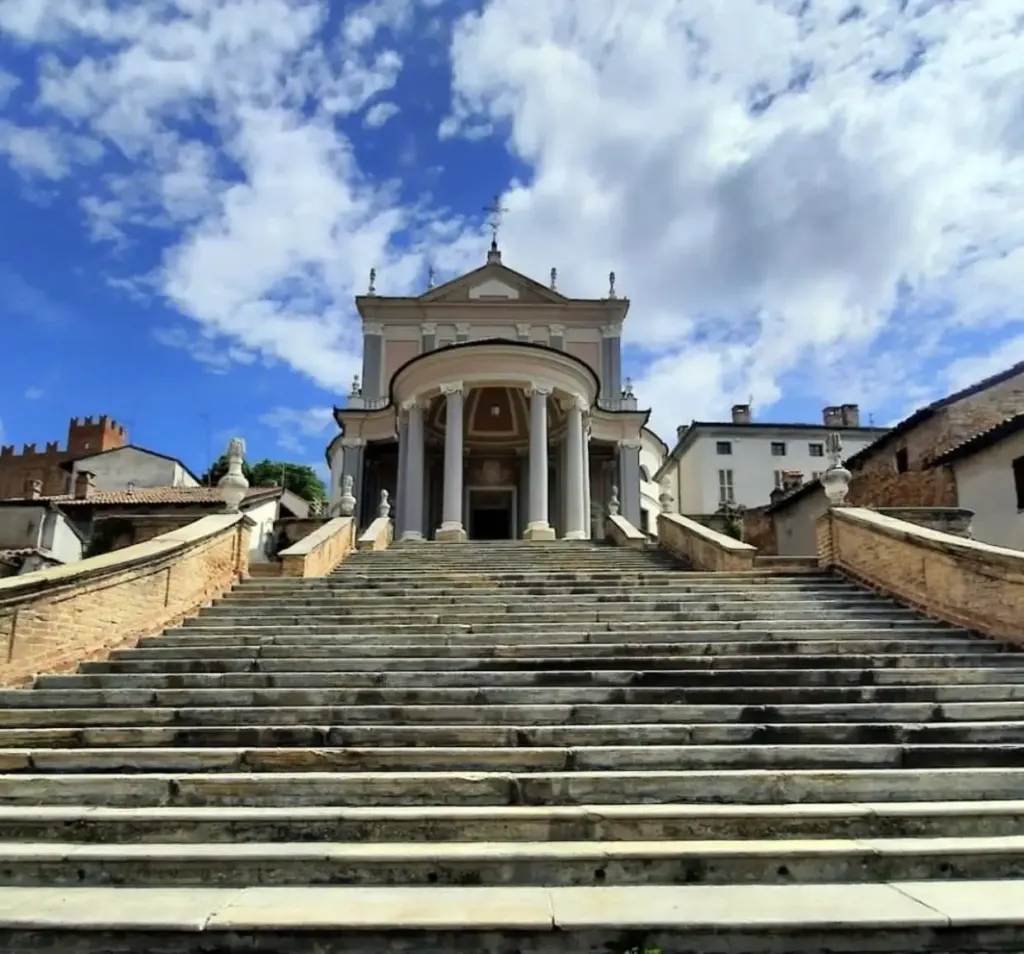
The piazza of the parish church of Santi Martino e Stefano, with its baroque staircase in Pietra di Cumiana, was described by La Stampa in 2006 as one of the most beautiful piazzas in Piedmont, drawing that comparison. [SOURCE TO VERIFY: La Stampa, 2006]
On 2 November 2023, by administrative renaming, to distinguish it from Italian homonyms.
Stay during the next Castelli Aperti opening:
Sources & References
Continue reading
Related articles
3 June 2026 Culture
Living Montemagno Monferrato
In this article1Why Montemagno, and Why Now2A Day in the Life: What Living Here Actually…
Read more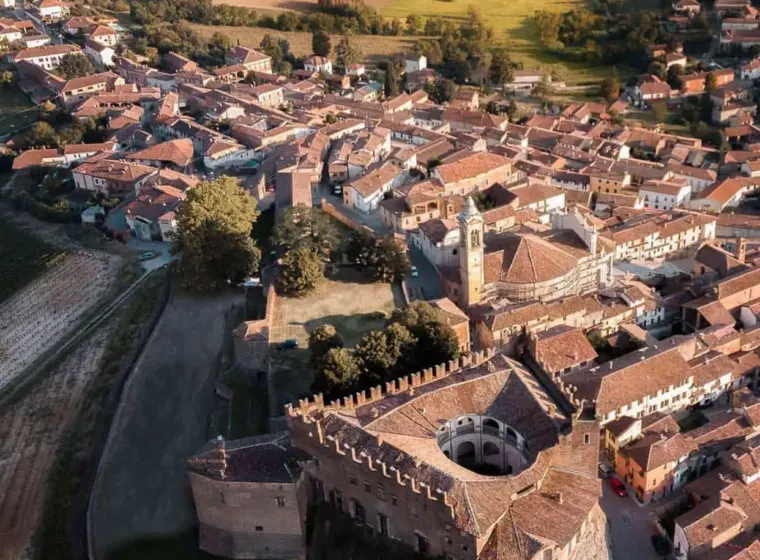
16 June 2026 Culture
The history of Montemagno Monferrato in ten moments
In this article11. 963: the Marchesato is born22. 981: the first keep33. 1269 and 1290:…
Read more