
Living Montemagno Monferrato

Italy · Piedmont · Monferrato · Asti Province · UNESCO World Heritage Landscape
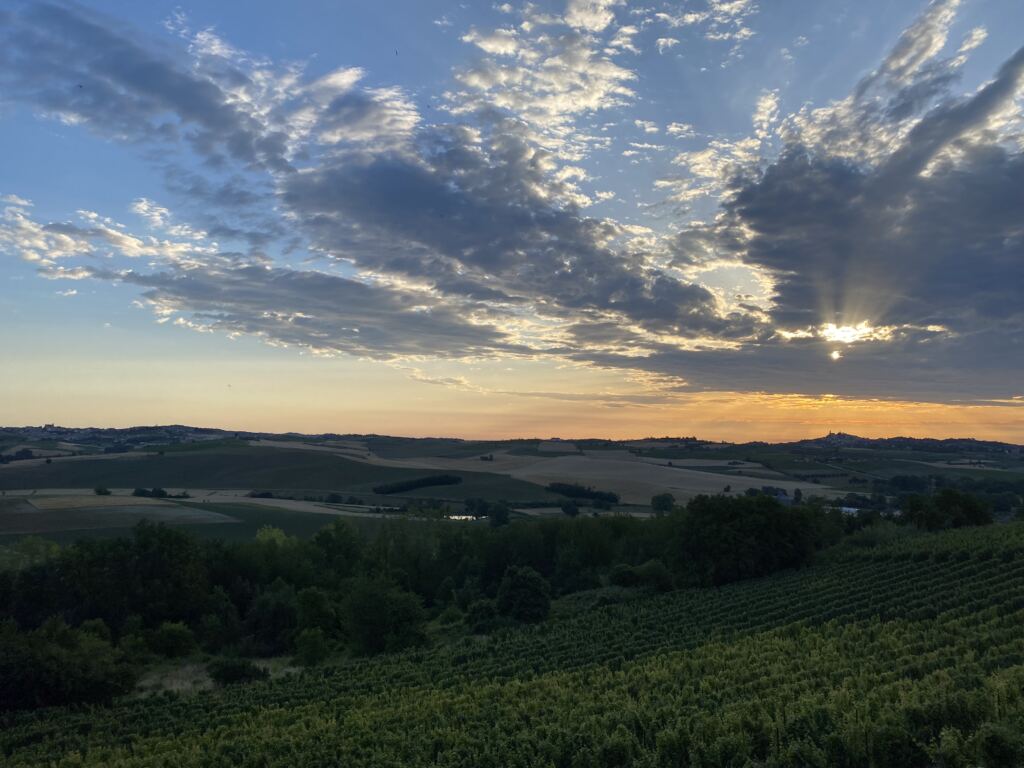
There is a specific quality of light in the Monferrato hills in September. It arrives low and lateral, grazing the vineyard rows, turning the red brick of the cascine a deeper amber. The air carries wood smoke and something that may be the last warmth of summer holding its ground. You are sitting at a table outside, your laptop open, your coffee cup almost empty. This is a normal Tuesday at Montemagno, Monferrato.
Montemagno is a comune of around 1,100 people in the province of Asti, Piedmont, set at between 240 and 280 metres above sea level in the heart of the Monferrato astigiano — the wine country that, since 2014, has formed part of the UNESCO World Heritage Site “Vineyard Landscape of Piedmont: Langhe-Roero and Monferrato” (UNESCO list n. 1390). It is not a resort, not a holiday destination, not a place discovered by travel supplements. It is a working village in a landscape shaped by seven centuries of viticulture, architecture, and slow, deliberate living.
This article is the starting point. It covers what Montemagno actually is, what daily life here looks like for someone who works remotely, what the land produces and how you eat it, how you arrive and move around, and how Ahoma makes the experience of living here genuinely accessible — for a week, a month, or longer. Specific chapters will follow as standalone articles. This is the map.
Why Montemagno, and Why Now
The question people ask is not why Tuscany or why Umbria. Those places are known, well-covered, often expensive. The question is why Piedmont, and why here. The answer is worth working through.
Monferrato sits in the north-west of Italy, geographically closer to Turin and Milan than to any coastline, and it operates on a different frequency from the more photographed corners of the country. It is not performing for the visitor. The castle of the Marchesi Calvi di Bergolo stands above the town in real use and private ownership — it is not a museum, not a boutique hotel. The church of the Assunta anchors the main piazza with the understated confidence of a building that has been doing this for several hundred years. The staircase below it, flanked by its neoclassical tempietto, is one of those small works of civic architecture that reward attention more than spectacle.
Montemagno is not performing for the visitor. That is precisely its value.
The practical argument is equally strong. Asti is 17 kilometres away and reachable in 20 minutes. Turin is 75 kilometres, Milan 100. Milan Malpensa airport — the main intercontinental hub for northern Italy — sits at roughly 1 hour 30 minutes by car. You are not isolated. You are insulated. The distinction matters enormously when you live here and work across time zones.
The UNESCO designation in 2014 formalized something the landscape had always been: a coherent, constructed environment shaped by human intelligence over centuries. The vineyard rows, the hilltop villages, the dispersed farmhouses, the particular light — these are not accidents of nature. They are the product of generations of decisions about what makes a place worth inhabiting. Montemagno is that, at a scale where the individual can feel it.
A Day in the Life: What Living Here Actually Looks Like
The morning in Montemagno begins early in the agricultural calendar and with it in daily rhythm. By 8:00 the two village bars are open, doing what small-town Italian bars have always done — espresso at the counter, a pastry, a brief exchange with whoever walked in before you. They are not destination cafés. They are not charming in any curated sense. They are functional, reliable, and honest: the morning infrastructure of a village that is still a village. That is, in its way, the point.
If you work remotely, your workday starts at a table — at home, on a terrace, in an agriturismo that informally provides a workspace for the week. The noise floor is structurally low. This is not something you manage with noise-cancelling headphones; it is built into the physical fabric of the place. No significant through traffic, no urban ambient density, no competing claims on your attention that you did not invite. For anyone who does deep work — writing, development, design, analysis — this structural silence is not a lifestyle choice but a functional advantage.
Lunch is straightforward and unhurried: a trattoria plate with the day’s pasta, a carafe of local wine from a producer three kilometres down the road, a price between 15 and 25 euros. In the afternoon, the valley fills slowly with heat. A walk of 40 minutes on a path between the vineyards, with a belvedere where you can see the Alps on a clear day, costs nothing and recalibrates everything. You return for the final hours of work.
The evening is where Montemagno shifts register. From 6pm onwards, two addresses define the social life of the village — and, increasingly, of the wider territory around it. Apedivino (Via Mezzana, 6) and Tramontemagno (Vicolo 1, 2 — tramontemagno.com) are both positioned on what functions as the natural balcony of the village: a vantage point where the hills open out to the west and the sunset arrives without interruption. The format is slow aperitivo — good wine from local producers, well-made cocktails, the kind of ease that comes when a place has been designed by people who actually live there and know what an evening should feel like. Neither is loud, neither is performing. Both are the kind of bar where you arrive not knowing anyone and find yourself still there two hours later. For guests of Ahoma, for temporary residents, for anyone navigating the social life of a small Italian town without existing contacts, these two places are the practical answer to the question of where to begin.
Working Remotely from Montemagno: The Honest Assessment
The remote work question deserves a straight answer, not a curated one. Here is what the infrastructure looks like.
Connectivity in the Monferrato is improving rapidly. Fibre optic coverage (FTTH) is expanding across the region, with many comuni having completed or actively completing rollout. Mobile 4G coverage is reliable within the village; in isolated agricultural zones it varies. The practical guidance is to verify the specific situation at your accommodation before a long stay — Ahoma does this as part of the preparation for every guest.
Italy operates on CET/CEST, which means solid overlap with all European time zones, clean morning synchrony with East Coast US (a 6-hour difference), and manageable — if disciplined — overlap with the West Coast. For the European remote professional, the Monferrato has no friction at all. For the American professional working primarily with European counterparts, it is similarly clean. The only configuration that requires real adaptation is full alignment with US Pacific time, where your working day effectively becomes evenings.
For anyone who does deep work, Montemagno’s structural silence is not a lifestyle choice — it is a functional advantage.
What Montemagno offers beyond connectivity is something less quantifiable: a rhythm that supports concentration. The absence of involuntary stimulation — the constant low-level demand of urban environments — is not something most people notice until they no longer have it. A two or three week stay here produces measurable effects on the quality of focused work. It is one of the things Ahoma guests consistently report.
For services: Montemagno has the essential layer of a functioning village — grocery shop, pastificio, bar, trattoria, pharmacy, post office, school, bank. For anything beyond that — hospital, large supermarkets, secondary schools, cinema, significant events — Asti (20 minutes by car) covers everything. The car is necessary in Monferrato; this is a frank observation. Local bike rental service handles the shorter distances with considerably more pleasure.
Wine, Food, and the Rhythm of the Seasons
Monferrato is a wine landscape. It is also a food culture. The two are inseparable here, and neither is the tourist version of itself.
The wines that matter in the immediate territory of Montemagno are primarily three. Ruché di Castagnole Monferrato DOCG is the most identitario: a red wine from an ancient autochthonous grape, grown in a tiny production zone of only seven comuni, Montemagno among them. It is aromatic — rose petals, violets, white pepper — and unlike anything produced elsewhere in Italy. Grignolino d’Asti DOC is its older cousin in the area: a pale, high-acid, tannic red that pairs with the local cuisine in ways that require no explanation once you experience them together. Barbera d’Asti DOCG rounds the picture — the workhorse grape of the region, here at its most expressive.
The wineries within a short drive of Montemagno — Montalbera, Tenuta Montemagno, Prediomagno, Hic et Nunc — are small, family-run operations with direct access for visits and tastings. The entry-level bottle from a good producer costs eight euros at the cellar door. This is not a detail about price; it is a statement about the relationship between quality and pretension in this part of Piedmont.
The kitchen is Piedmontese di collina: pastures, hills, seasons. Agnolotti del plin — small hand-pinched pasta stuffed with braised meat — served asciutti or in brodo. Tajarin, the egg pasta cut paper-thin, with butter and white truffle in autumn. Vitello tonnato in summer. Bagna càuda — the ritual dish of the Monferrato, a warm sauce of anchovies and garlic into which you dip raw and cooked vegetables, eaten in company — arrives with the cold months and is among the most social acts the local culture performs. In autumn, white truffle from the territory around Alba (50 kilometres south) and the local truffle fairs at Moncalvo transform the already serious local table into something extraordinary.
The agricultural calendar structures everything. September is the vintage, the truffle season, the golden light. October and November deepen the palette — foliage on the vines, fog in the valleys, fire in the evenings. Spring brings the asparagus, the fresh robiola cheese, the first warm evenings. It is a place where the year has real shape, and where the shape of the year is felt in what you eat.
Getting to Montemagno: Distances and Connections
The accessibility of Montemagno is better than its profile suggests. From Milan, it is approximately 1 hour 15 minutes on the A21 motorway, exiting at Asti Est or Felizzano. From Turin, around 50 minutes. The train from Milan Centrale to Asti takes approximately 1 hour 40 minutes (with connections); from Asti station, Montemagno is a further 20 minutes by car or a less frequent provincial bus.
For international arrivals: Milan Malpensa (MXP) handles the intercontinental traffic and sits at roughly 1 hour 30 minutes by car. Turin-Caselle (TRN) is around 70 minutes. Genoa (GOA) offers access from selected European routes at a similar distance. Bergamo Orio al Serio (BGY), the main low-cost hub for northern Italy, is approximately 2 hours.
Within the territory, a car is the honest answer for independence. The roads between villages are provincial and well-maintained; the distances between the most interesting places — wineries, towns, viewpoints — are rarely more than 15 kilometres. For movement within Montemagno and to immediately adjacent villages, the bicycle is not a concession to fitness culture but the most appropriate instrument for the scale of the place. The Monferrato is recognised internationally as one of Italy’s finest gravel cycling destinations; the network of white agricultural roads connecting the vineyard estates is the terrain for it.
Where to Stay & Live the Experience: Ahoma in Montemagno
Ahoma is a platform for choosing how to live — temporarily, semi-permanently, or with a view to something more lasting. The Ahoma village at Montemagno is designed around the specific proposition of this territory: stay long enough to understand what it means to be here, work comfortably from a space that is built for it, and enter the place rather than observe it from the outside.
The accommodation options range from short stays to extended mid-term rentals, calibrated for the needs of the remote professional, the creative working on a project, the couple making a considered decision about where they want to live next. The infrastructure includes reliable high-speed connectivity, real working spaces, bike rental built into the service, and — critically — the human layer of community: other guests with similar sensibilities, local producers, professionals who live in the territory and know it in detail.
What Ahoma adds to the raw quality of Montemagno is the friction removed. Finding an apartment in a small Piedmontese village without Italian, without local contacts, without knowledge of how things work here, is not impossible but it is effortful. Ahoma handles that. What remains is the place itself — the September light, the Ruché in the evening, the quiet Tuesday morning at the desk — and the community that forms around people who have chosen it.
Experiences organised through Ahoma’s network in Montemagno include wine tastings at selected local producers, guided walks through the vineyard landscape, introductions to the local artisan food culture, and — seasonally — participation in the events that define the Monferrato calendar: the harvest, the truffle season, the traditional village festivals.
Ahoma removes the friction. What remains is the place itself.
FAQ
Yes, with one honest qualification. The connectivity infrastructure — fibre broadband, solid 4G coverage — is in place for most of the village. The working conditions are excellent: low noise, a pace that supports deep focus, and a time zone (CET/CEST) that overlaps cleanly with Europe and the US East Coast. The qualification is that Montemagno is a small village, not a city: if your work requires daily in-person meetings or frequent travel, you will need to plan around the car and the nearest rail connection at Asti.
Significantly lower across most categories. Renting a renovated and serviced house in the village centre runs approximately 1.000-1.800 euros for a month, a classic home to rent can cost from 700 to 1000 euros per month (+utilities and eventual furniture) on a longer term contract. A lunch at the local trattoria costs 15–25 euros including wine. A bottle of excellent local wine bought directly from the producer starts at 8 euros. For anyone relocating from a major Western European city or from New York, San Francisco, or London, the cost-quality ratio is among the most favourable in northern Italy.
Ahoma offers stays ranging from short visits (one day, one week and above) to mid and long-term arrangements for professionals who want to work from Montemagno for a month or more. All stays include connectivity, working space, and access to Ahoma’s network of local experiences and community. Contact Ahoma directly to discuss the format that fits your situation.
September is the consensus answer, and it earns that reputation: the grape harvest, the first white truffles, long evenings with warm days and cool nights, and the particular amber light that defines the Monferrato’s visual identity. May and June are excellent for the flowering landscape and mild temperatures. Winter — November through February — is colder and quieter, suited to concentrated work stays and the ritual warmth of the local table. Every season in Monferrato is worth inhabiting on its own terms.
Yes. The village has a primary school and nursery, essential services, and the kind of physical safety and quiet pace that many families are actively seeking. The international community in the Monferrato — Swiss, British, German, American, Dutch residents have been a consistent presence for 15–20 years — means there is a legible network of people who have made the transition and can guide it. Ahoma can make introductions.
Continue reading
Related articles

4 June 2026 Living
Second article
Lorem ipsum dolor sit amet, consectetur adipiscing elit, sed do eiusmod tempor incididunt ut labore…
Read more